


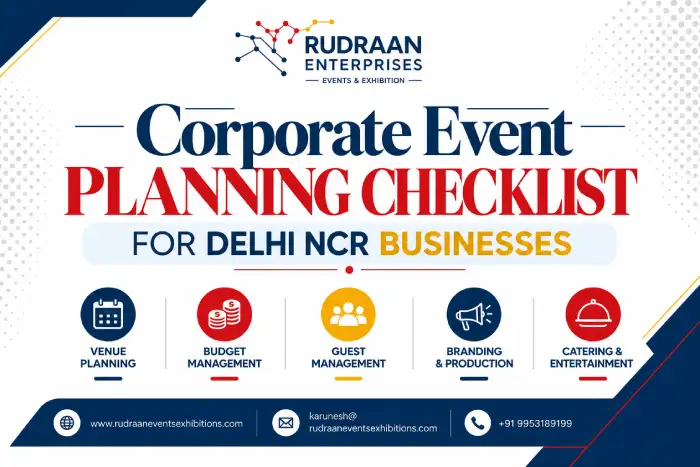
Planning a corporate event in Delhi NCR involves much more than booking a venue and sending invitations. From choosing the right location and managing guests to coordinating branding, production, catering, entertainment, and event-day logistics, every detail needs to work together.
Whether you are organising a corporate conference, annual day, product launch, dealer meet, seminar, award ceremony, networking event, or employee celebration, a clear planning checklist can help you stay organised and reduce last-minute problems.
For businesses in Delhi NCR, the planning process can also involve additional considerations such as venue accessibility, traffic, parking, guest travel, vendor coordination, production requirements, and event permissions.
This guide provides a practical corporate event planning checklist for Delhi NCR businesses.
Why You Need a Corporate Event Planning Checklist
Corporate events often involve multiple teams, vendors, deadlines, and decisions.
Without a proper plan, important details can easily be missed.
A structured checklist helps you:
- Keep planning organised
- Track important deadlines
- Control the event budget
- Coordinate different vendors
- Manage guest requirements
- Plan technical production
- Maintain consistent branding
- Prepare for unexpected issues
- Improve the overall guest experience
The earlier you start planning, the more time you have to identify and solve potential problems.
Corporate Event Planning Checklist at a Glance
| Planning Area | Key Things to Check |
|---|---|
| Event Objective | Purpose, audience and expected outcome |
| Budget | Venue, production, catering, branding and contingency |
| Date | Availability, business schedule and guest convenience |
| Venue | Location, capacity, parking and facilities |
| Guest List | Employees, clients, partners, VIPs and speakers |
| Event Theme | Creative concept and overall experience |
| Branding | Logo, colours, stage, signage and digital displays |
| Production | Sound, lighting, LED screens and technical setup |
| Catering | Menu, service style and dietary requirements |
| Entertainment | Emcee, music, performances or activities |
| Invitations | Registration, invitations and event communication |
| Logistics | Transport, parking, accommodation and vendor access |
| Safety | Crowd management, technical safety and emergency planning |
| Event Day | Run sheet, vendor coordination and execution |
| Post Event | Feedback, results, photos and performance review |
1. Define the Purpose of Your Corporate Event
Before booking anything, clearly define why the event is being organised.
Your objective will influence almost every other decision.
Common Corporate Event Objectives
Your event could be designed to:
- Launch a product
- Celebrate a company milestone
- Conduct a conference
- Organise an annual day
- Host a dealer or distributor meet
- Recognise employees
- Build client relationships
- Generate business leads
- Conduct training
- Create networking opportunities
- Strengthen company culture
Write the primary objective down before moving forward.
A clear objective helps prevent the event from becoming a collection of unrelated activities.
2. Identify Your Target Audience
The next step is to understand who will attend.
Your guest profile affects the venue, programme, communication, catering, entertainment, and overall event style.
Your Guest List May Include
- Employees
- Senior management
- Clients
- Business partners
- Dealers
- Distributors
- Investors
- Speakers
- Industry professionals
- VIP guests
Also estimate the expected number of attendees.
A venue suitable for 150 guests may not work for 500, while booking an unnecessarily large venue can increase costs.
3. Set Your Corporate Event Budget
Budget planning should happen before major bookings are made.
Create separate budget categories so you can see where the money is being allocated.
Important Budget Areas
Include:
- Venue
- Stage and set design
- Audio-visual equipment
- Lighting
- Branding
- Catering
- Entertainment
- Photography and videography
- Event staff
- Invitations and communication
- Transportation
- Accommodation, if required
- Décor
- Technology
- Contingency expenses
Keep a contingency amount for unexpected requirements.
This can be particularly useful when the event involves multiple vendors and production elements.
4. Select the Right Date
The event date can affect attendance and venue availability.
Before finalising the date, consider:
- Business calendars
- Important company dates
- Guest availability
- Speaker availability
- Venue availability
- Travel requirements
- Exhibition or industry schedules
- Public holidays
- Expected traffic conditions
For events involving important clients or senior executives, confirming availability early can help avoid unnecessary changes later.
5. Choose the Right Venue in Delhi NCR
Venue selection is one of the most important decisions in corporate event planning.
Delhi NCR offers many types of venues, including hotels, convention spaces, banquet halls, business centres, outdoor venues, and dedicated event spaces.
Check These Venue Requirements
Capacity:
Can the venue comfortably accommodate your expected audience?
Location:
Is it convenient for your guests?
Parking:
Does it provide adequate parking or nearby parking options?
Accessibility:
Can guests reach the venue easily?
Technical Facilities:
Does the venue support your AV and production requirements?
Catering:
Can the venue provide the required menu and service style?
Branding Restrictions:
Check whether the venue has limitations on stage design, signage, branding, or installations.
Setup Time:
Confirm how much time vendors have for installation before the event.
6. Consider Delhi NCR Travel and Traffic
For businesses organising events in Delhi NCR, guest travel should be considered during planning.
Depending on the location and event timing, travel time can affect guest arrival.
Consider:
- Metro accessibility
- Road connectivity
- Parking
- Pickup and drop-off arrangements
- Traffic conditions
- Guest travel distance
- Airport or railway connectivity for outstation guests
For VIPs, speakers, or important business guests, dedicated transportation may be appropriate.
A convenient venue can contribute significantly to the overall guest experience.
7. Finalise the Event Theme and Concept
A corporate event doesn’t have to look generic.
A creative concept can make the event more memorable while maintaining a professional identity.
Your concept can influence:
- Stage design
- Entrance
- Lighting
- Branding
- Digital screens
- Décor
- Guest experience
- Entertainment
The theme should support the purpose of the event rather than simply being decorative.
8. Plan Corporate Branding
Your event should look consistent with your company’s identity.
Branding can be included across:
- Entrance signage
- Registration counters
- Stage backdrop
- LED screens
- Presentation screens
- Directional signage
- Photo areas
- Event materials
- Digital content
Use your brand colours, typography, logo, and messaging consistently.
Avoid overcrowding the venue with logos.
Professional corporate branding is usually more effective when it is clear, consistent, and strategically placed.
9. Plan Stage and Event Production
Production can become one of the most important components of a corporate event.
Depending on the event, you may require:
- Stage
- LED wall
- Projection
- Sound system
- Microphones
- Stage lighting
- Presentation screens
- Confidence monitors
- Podium
- Special lighting effects
- Technical operators
The production setup should be planned around the venue and event programme.
10. Prepare the Audio-Visual Setup
Technical issues can quickly affect a corporate event.
Before the event, confirm:
- Number of microphones
- Speaker requirements
- Presentation format
- LED screen dimensions
- Video playback
- Laptop connections
- Audio requirements
- Lighting
- Power requirements
- Backup equipment
A technical rehearsal is strongly recommended before guests arrive.
11. Prepare the Guest Invitation and Registration Process
Your guest experience begins before they enter the venue.
Create a clear invitation and registration process.
Your communication should provide:
- Event name
- Date
- Time
- Venue
- Location details
- Parking information
- Registration instructions
- Dress code, if applicable
- Contact information
For larger events, digital registration and QR-based check-in can help reduce queues.
12. Plan Catering and Hospitality
Food and hospitality can have a significant impact on guest satisfaction.
Choose the catering style based on your event format.
Options May Include
- Welcome refreshments
- Tea and coffee
- Breakfast
- Working lunch
- Buffet
- Plated dinner
- Networking snacks
- Live food counters
Also consider:
- Vegetarian options
- Dietary requirements
- Allergies
- Beverage requirements
- VIP hospitality
For corporate events, timing is especially important. Catering should not unnecessarily interrupt presentations or important programme sessions.
13. Select Appropriate Entertainment
Entertainment should match the event type and audience.
Depending on the event, you may consider:
- Professional emcee
- Live music
- DJ
- Cultural performance
- Stand-up comedy
- Interactive activities
- Celebrity appearance
- Team-building activities
The entertainment should support the event rather than take attention away from its main purpose.
For more ideas, your Day 4 article — Best Event Entertainment Ideas for 2026 can be internally linked here.
14. Plan Speaker and VIP Management
If your event includes speakers, executives, or VIP guests, create a dedicated plan for them.
Confirm:
- Arrival time
- Transportation
- Accommodation if required
- Stage requirements
- Presentation files
- Microphone requirements
- Introduction details
- Seating
- Hospitality
- Departure arrangements
Assign one team member to coordinate important speakers and VIPs on event day.
15. Create a Detailed Event Schedule
Your event programme should clearly define what happens and when.
For example:
Guest Arrival → Registration → Welcome → Opening → Keynote → Presentation → Break → Main Session → Networking → Entertainment → Closing
Include buffer time wherever possible.
A realistic schedule is easier to execute than one where every activity is planned back-to-back.
16. Coordinate All Vendors
Corporate events can involve multiple vendors.
These may include:
- Venue
- Caterer
- Decorator
- Stage fabricator
- AV team
- Lighting team
- Entertainment
- Photographer
- Videographer
- Transportation
- Event staff
- Branding and printing teams
Create one central contact sheet containing:
- Vendor name
- Contact person
- Phone number
- Service
- Arrival time
- Setup requirements
- Payment status
This makes event-day coordination much easier.
17. Prepare Event-Day Logistics
Create a detailed logistics plan before the event.
Check:
- Vendor entry
- Loading and unloading
- Parking
- Guest entry
- Registration
- Staff access
- Equipment movement
- Storage
- VIP movement
- Emergency access
For larger venues, clearly define where each vendor should report.
18. Prepare a Backup Plan
Even well-planned events can experience unexpected problems.
Prepare alternatives for:
- Technical failures
- Speaker delays
- Vendor delays
- Transportation problems
- Schedule changes
- Power issues
- Unexpected guest numbers
- Outdoor weather conditions
The objective isn’t to predict every possible problem.
It’s to make sure your team knows what to do if something goes wrong.
19. Conduct a Final Pre-Event Inspection
Before guests arrive, inspect the entire venue.
Final Venue Checklist
- Stage completed
- Branding installed
- LED screens tested
- Sound tested
- Lighting tested
- Seating arranged
- Registration ready
- Catering ready
- Guest signage installed
- VIP area prepared
- Presentations loaded
- Entertainment ready
- Emergency arrangements checked
- Event team briefed
A final walkthrough can identify small problems before they become visible to guests.
20. Assign an Event-Day Management Team
Everyone should know their responsibility.
For example:
Event Manager: Overall coordination
Production Manager: Stage, AV and technical requirements
Guest Team: Registration and guest assistance
Hospitality Team: Catering and VIP support
Entertainment Coordinator: Performers and programme
Vendor Coordinator: Vendor communication and setup
Clear responsibilities reduce confusion during the event.
21. Measure the Event After It Ends
The planning process doesn’t end when the event finishes.
Review whether the event achieved its objective.
Useful Metrics
Depending on the event, you can measure:
- Attendance
- Registration numbers
- Guest feedback
- Employee participation
- Client engagement
- Leads generated
- Networking meetings
- Brand visibility
- Social media engagement
- Budget performance
Use these insights to improve future corporate events.
Corporate Event Planning Checklist — Final Version
Before your event, make sure you have completed:
Strategy
- Event objective defined
- Target audience identified
- Expected attendance estimated
- Event format selected
Budget
- Overall budget approved
- Vendor costs estimated
- Production costs included
- Catering budget confirmed
- Contingency budget reserved
Venue
- Venue selected
- Capacity confirmed
- Parking checked
- Accessibility checked
- Setup time confirmed
- Branding restrictions checked
Branding & Design
- Event theme finalised
- Stage design approved
- Branding artwork approved
- Signage prepared
- Digital content prepared
Production
- Sound confirmed
- Lighting confirmed
- LED/display confirmed
- Microphones arranged
- Presentation equipment tested
- Backup equipment arranged
Guests
- Guest list finalised
- Invitations sent
- Registration arranged
- VIP list prepared
- Transportation planned where required
Hospitality
- Catering finalised
- Menu approved
- Dietary requirements checked
- VIP hospitality arranged
Entertainment
- Entertainment selected
- Performer confirmed
- Technical requirements checked
- Performance schedule confirmed
Event Day
- Vendor arrival schedule shared
- Event run sheet prepared
- Team responsibilities assigned
- Final venue inspection completed
- Emergency plan prepared
- Technical rehearsal completed
After the Event
- Guest feedback collected
- Event performance reviewed
- Photos and videos organised
- Leads followed up
- Budget reviewed
Why Choose Rudraan Events & Exhibitions for Corporate Events?
Planning a corporate event involves coordinating many moving parts, and having an experienced event management partner can make the process more organised.
Rudraan Events & Exhibitions works across Corporate Events, Exhibitions, Weddings, and Entertainment, bringing creative planning and event execution together.
For corporate events, the focus can include:
- Event planning
- Venue coordination
- Stage and production
- Corporate branding
- Guest management
- Entertainment
- Vendor coordination
- Event-day execution
The approach should always begin with understanding the company’s objective, audience, venue, budget, and desired guest experience.
Final Thoughts
A successful corporate event doesn’t happen by accident.
From choosing the right venue in Delhi NCR to planning the budget, guest experience, branding, production, catering, entertainment, and event-day coordination, every element needs to be planned carefully.
Use this corporate event planning checklist as a practical starting point and customise it according to the size, purpose, audience, and format of your event.
Most importantly, give yourself enough planning time. Early preparation gives your team more flexibility, better vendor options, and more time to solve unexpected issues.
Planning a Corporate Event in Delhi NCR?
If you’re organising a corporate event in Delhi NCR and need professional support with planning, production, branding, coordination, and execution, Rudraan Events & Exhibitions can help bring the different elements together.
Corporate Events | Exhibitions | Weddings | Entertainment