

Launching a new product is an important milestone for any business. Whether you are introducing a new technology, consumer product, luxury brand, or innovative service, a well-planned product launch event can help you attract attention, connect with your target audience, and create a memorable first impression.
However, a successful product launch requires more than simply presenting a product on stage. The right venue, creative theme, engaging activities, professional production, and effective audience interaction all contribute to the overall experience.
At Rudraan Events & Exhibitions, we understand the importance of creating events that communicate a brand’s identity and engage its audience. With thoughtful planning and professional execution, businesses can turn a product introduction into an exciting brand experience.
In this guide, we explore practical product launch event ideas that can help your business generate interest, encourage audience participation, and make your launch more memorable.
Why Is a Product Launch Event Important?
A product launch event gives businesses an opportunity to introduce their latest offerings directly to customers, industry professionals, media representatives, business partners, and potential buyers.
Unlike a standard product announcement, a well-designed event allows people to experience the product, understand its benefits, and interact with the brand.
Here are some important benefits of organising a product launch event:
- Build brand awareness: Introduce your product to a relevant audience and create opportunities for people to discover your brand.
- Generate audience interest: Use presentations, demonstrations, and interactive activities to capture attention.
- Encourage product trials: Allow guests to experience selected product features where appropriate.
- Strengthen business relationships: Bring customers, distributors, partners, and industry professionals together.
- Create content opportunities: Capture photographs, videos, interviews, and demonstrations for future marketing campaigns.
- Communicate product value: Explain what makes your product useful, different, or relevant to your target audience.
The key is to plan an event around your product, audience, and business objectives rather than following a generic event format.
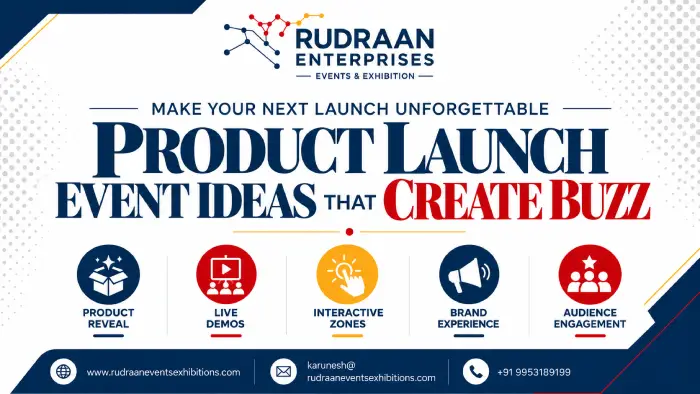
12 Product Launch Event Ideas That Create Buzz
A creative product launch should give attendees a reason to pay attention, participate, and remember what they experienced. The following ideas can be adapted to different industries, audiences, budgets, and venue sizes.
1. Create a Dramatic Product Reveal
A product reveal is often the highlight of a launch event. Instead of displaying the product immediately, build anticipation before introducing it to the audience.
You can use a branded stage, controlled lighting, background music, LED screens, and a coordinated presentation to create a memorable reveal.
For example, a technology company launching a new device might begin with a short introductory film highlighting the problem the product solves. The presenter can then introduce the product through a coordinated lighting and visual sequence.
Tips for an effective product reveal:
- Keep the introduction focused and relevant to the product.
- Use lighting and audiovisual effects that complement the brand.
- Ensure the product is clearly visible from different seating areas.
- Rehearse the reveal with the stage and technical teams.
- Prepare a backup plan for screens, lighting, and presentation equipment.
The reveal should generate excitement without distracting the audience from the product itself.
2. Choose a Creative Product Launch Theme
A consistent theme helps connect the venue, stage design, guest experience, promotional materials, and event activities.
Your theme should reflect the product’s personality and the message your business wants to communicate.
For example:
- Technology launches: Futuristic styling, digital displays, and interactive demonstrations.
- Luxury product launches: Elegant décor, refined lighting, premium materials, and carefully planned guest experiences.
- Sustainable product launches: Natural materials, reusable décor, and displays that communicate the product’s environmental features accurately.
- Lifestyle product launches: Contemporary styling, experiential displays, and photography-friendly spaces.
- Automotive launches: Dramatic vehicle presentation, structured viewing areas, and product demonstrations where suitable.
Choose a theme that supports the product story instead of adding decorative elements without a clear purpose.
3. Organise a Live Product Demonstration
A live demonstration allows attendees to see how a product works and understand its practical benefits.
This approach is particularly useful for electronics, software, machinery, home appliances, beauty products, and other products whose features are best explained through a demonstration.
Instead of relying entirely on a presentation, demonstrate the product’s key functions in a realistic and easy-to-understand way.
How to make your demonstration effective:
- Focus on two or three important features.
- Explain how those features address customer needs.
- Use large displays when the demonstration is difficult to see from a distance.
- Give attendees opportunities to ask questions.
- Test all equipment and product functions before the event.
- Prepare recorded demonstrations or alternative equipment in case of technical problems.
A clear demonstration helps transform product claims into an experience that attendees can understand.
4. Design an Interactive Product Experience Zone
An interactive experience zone gives guests an opportunity to explore the product at their own pace.
Depending on your product, this area might include demonstration counters, product testing stations, digital interfaces, consultation desks, or guided experiences.
For example, a company launching a new consumer electronic device could create separate stations for product features, usability demonstrations, and customer questions.
For a beauty product launch, a dedicated consultation or trial area may be more appropriate.
When designing the experience zone, consider:
- The number of expected visitors.
- The time required for each interaction.
- Product safety and handling requirements.
- Accessibility and movement between stations.
- Staff availability to answer questions.
- Clear signage explaining each activity.
A well-organised experience zone encourages participation while helping prevent congestion.
5. Invite Industry Experts and Relevant Influencers
Guest speakers, industry experts, creators, and influencers can help introduce your product to audiences who are interested in its category.
However, choosing guests based only on popularity may not deliver the desired results. The people you invite should be relevant to your product, target audience, and communication goals.
Consider inviting:
- Industry specialists who can discuss the product category.
- Relevant content creators who regularly engage with your target audience.
- Existing customers who can share genuine experiences, where appropriate.
- Business partners or distributors.
- Journalists and media representatives whose coverage aligns with the product.
Provide invited guests with accurate product information, the event schedule, photography guidelines, and any relevant brand communication requirements.
If promotional content or paid partnerships are involved, ensure that applicable disclosure requirements are followed.
6. Create a Branded Photo and Video Zone
A branded photo zone gives attendees an opportunity to capture and share moments from your launch event.
Instead of creating a generic backdrop, design a space that reflects the product’s identity and encourages natural interaction.
You could include:
- A branded background featuring the product.
- A product display with suitable lighting.
- A carefully designed installation related to the launch theme.
- A demonstration area suitable for short videos.
- A designated media and interview backdrop.
Keep the branding visible without overcrowding the design with logos and promotional messages.
You should also consider where the photo zone will be positioned. It should be easy to find without blocking the entrance, registration desk, or main audience movement.
With the right setup, this area can support both the guest experience and your post-event marketing content.
7. Use LED Screens and Audiovisual Production
Professional audiovisual production helps communicate the product story and keeps the audience engaged throughout the event.
LED screens, projection, presentation graphics, sound systems, and lighting can all contribute to a more polished experience when they are planned around the event’s objectives.
For example, a product launch might include an introductory video, a live presentation, product specifications, customer use cases, and a final reveal.
To achieve a smooth experience:
- Use readable text and high-quality visuals.
- Match the screen content to the speaker’s presentation.
- Test video playback and presentation files in advance.
- Ensure microphones and speakers provide clear sound.
- Arrange suitable lighting for both the stage and the audience.
- Keep backup files and essential equipment available.
Technology should improve communication, not make the event unnecessarily complicated.
8. Introduce a Live Q&A or Expert Session
A product launch should give attendees an opportunity to understand the product beyond its promotional message.
A question-and-answer session can help address concerns, clarify features, and encourage meaningful conversations between the brand and its audience.
You could invite the product manager, technical specialist, designer, or business leader to answer relevant questions.
For a professional launch, questions might cover product functionality, availability, intended use, support, or implementation.
For a consumer product, the discussion might focus on everyday applications, usability, or product selection.
Prepare a moderator, allocate sufficient time, and provide a microphone for audience questions. If the audience is large, consider collecting questions digitally or through the registration process.
The aim is to make the session informative, accessible, and relevant to attendees.
9. Offer Personalised Guest Experiences
Personalisation can help attendees feel that the event has been designed with their interests in mind.
The type of personalisation will depend on your audience and the product.
Possible ideas include:
- Personalised invitations for priority guests.
- Product demonstrations tailored to different customer groups.
- Guided product consultations.
- Dedicated meetings for business partners.
- Customised product information packs.
- Follow-up sessions based on attendees’ interests.
For a business-to-business launch, scheduled meetings with distributors or potential clients may be more valuable than general entertainment.
For a consumer-facing event, hands-on demonstrations and personalised recommendations may be more effective.
Focus on activities that make the event more useful to attendees and support your business goals.
10. Add Live Entertainment Where It Fits the Brand
Entertainment can contribute to the atmosphere of a product launch, particularly when the event is designed to create excitement and bring guests together.
Depending on the audience and brand identity, you might consider live music, a professional host, a DJ, a cultural performance, or a short creative presentation.
However, entertainment should complement the product rather than compete with it.
For example, a premium lifestyle brand might choose subtle live music during guest arrival, while a high-energy consumer launch might benefit from a more dynamic opening sequence.
When planning entertainment, consider the audience profile, venue restrictions, event duration, sound requirements, and overall budget.
The best entertainment choice is one that strengthens the experience while leaving sufficient time for the product presentation and audience interaction.
11. Create a Memorable Launch Invitation and Registration Experience
The guest experience begins before attendees arrive at the venue.
A well-designed invitation and organised registration process can build anticipation and make the event feel professional from the beginning.
Your invitation should communicate the essential details clearly, including the event purpose, date, time, venue, registration instructions, and any relevant attendance requirements.
You can use email invitations, personalised messages, event registration pages, or other channels that suit your audience.
On the event day, consider the following:
- A clearly marked registration desk.
- A prepared guest list or digital check-in system.
- Staff available to welcome and guide attendees.
- Appropriate arrangements for priority guests.
- Clear directions to the main event area.
- A simple process for handling late registrations.
Avoid creating unnecessary delays at the entrance. A smooth arrival experience sets a positive tone for the rest of the event.
12. Extend the Launch Through Post-Event Marketing
A product launch does not have to end when the last guest leaves.
Post-event communication helps maintain interest and gives your business additional opportunities to share product information with attendees and wider audiences.
Depending on your goals, you could publish:
- A highlights video.
- Professional event photographs.
- Product demonstration clips.
- Key takeaways from the launch presentation.
- Speaker or guest interviews.
- A post-event email with product information.
- Follow-up invitations for demonstrations or consultations.
You can also share relevant content across your website, social media channels, email campaigns, and sales presentations.
Make sure any published photographs, recordings, and promotional materials are used with the necessary permissions.
For better measurement, track relevant outcomes such as qualified enquiries, demonstration requests, registrations, audience engagement, media coverage, and sales opportunities.
The purpose is to turn the attention generated by the launch into meaningful next steps.
How to Choose the Right Product Launch Event Format
Not every product needs a large-scale launch. The right format depends on the product, audience, budget, and expected outcomes.
Here are some common approaches to consider.
Corporate Product Launch
A corporate launch is suitable for introducing products or services to business clients, distributors, investors, employees, or industry professionals.
It may include a formal presentation, product demonstration, leadership address, networking session, and scheduled meetings.
The focus should be on communicating the product’s value and supporting business relationships.
Experiential Product Launch
An experiential launch allows guests to interact directly with the product through demonstrations, trial areas, guided activities, or immersive displays.
This format works well when experiencing the product helps people understand its features and benefits.
The design should prioritise accessibility, practical demonstrations, and smooth visitor movement.
Media and Influencer Launch
A media-focused launch is designed to introduce a product to relevant journalists, creators, and industry commentators.
It may include a press briefing, product demonstration, interviews, photography opportunities, and access to product information.
Preparation is essential because media representatives may need specific information, interview opportunities, and suitable working areas.
Private or VIP Product Launch
A private launch is useful when the target audience is relatively small or when the product benefits from a more personalised presentation.
It could include an invitation-only demonstration, a private viewing, a networking reception, or one-to-one consultations.
The emphasis should be on guest comfort, relevant conversations, and a carefully managed experience.
Virtual or Hybrid Product Launch
A virtual or hybrid launch can help businesses reach audiences who cannot attend the physical venue.
A hybrid event combines an in-person experience with online participation, while a fully virtual event takes place online.
If you choose this format, plan the online audience experience carefully. Clear audio, reliable streaming, readable presentations, and a designated production team are important.
The best format is the one that reaches the intended audience and supports the product’s launch objectives.
Product Launch Event Planning Checklist
A successful launch requires coordination across creative, technical, logistical, and communication activities.
Use the following checklist to organise the key tasks.
Before the Event
- Define the launch objectives and target audience.
- Confirm the product’s key messages and presentation requirements.
- Establish the budget and approval process.
- Select a suitable venue and event format.
- Finalise the theme, stage design, and branding.
- Plan product demonstrations and interactive activities.
- Confirm speakers, hosts, entertainment, and other participants.
- Arrange audiovisual equipment, lighting, and production.
- Prepare invitations, registration, and guest communication.
- Develop the event schedule and assign responsibilities.
- Arrange photography, videography, and media requirements.
- Review venue access, safety, accessibility, and technical requirements.
During the Event
- Manage registration and guest arrival.
- Coordinate speakers and the event schedule.
- Check sound, lighting, screens, and presentations.
- Ensure the product is ready for display or demonstration.
- Support attendees at interactive zones.
- Coordinate photography and video coverage.
- Monitor audience movement and venue requirements.
- Resolve unexpected issues through the event management team.
After the Event
- Collect relevant attendance and engagement data.
- Send follow-up communication to attendees.
- Share approved photographs and event highlights.
- Respond to enquiries and product demonstration requests.
- Coordinate sales or business development follow-ups.
- Review performance against the original objectives.
- Document lessons for future events.
This checklist provides a useful starting point. The exact requirements will vary depending on the product, event format, venue, and number of attendees.
Common Product Launch Event Mistakes to Avoid
Even a creative launch can fall short if essential planning details are overlooked.
1. Focusing on Décor Instead of the Product
Attractive décor can improve the experience, but the product must remain the main focus. Ensure that the stage, lighting, screens, and displays support the product story.
2. Ignoring the Target Audience
An event designed for business buyers may require a different approach from one intended for consumers. Understand your audience before choosing the format, activities, and entertainment.
3. Overloading the Event Schedule
Too many presentations and activities can leave attendees tired or distracted. Build a realistic schedule with sufficient time for the product reveal, demonstrations, questions, and networking.
4. Underestimating Technical Requirements
Screen problems, unclear audio, and untested presentations can disrupt the experience. Arrange technical checks and rehearsals before the event begins.
5. Neglecting Guest Movement
Poorly positioned registration desks, product displays, and activity areas can cause congestion. Plan the venue layout to support comfortable movement and clear access.
6. Forgetting Post-Event Follow-Up
A launch may attract interest, but that interest needs to be managed. Prepare a follow-up plan for enquiries, meetings, product demonstrations, and relevant marketing communication.
Avoiding these mistakes can help your team deliver a more organised, engaging, and purposeful event.
How Rudraan Events & Exhibitions Can Help Plan Your Product Launch
Planning a product launch involves coordinating multiple elements, from the initial concept and venue layout to production, guest management, and event-day execution.
Rudraan Events & Exhibitions provides event management and production support for businesses looking to create professional, well-coordinated event experiences.
Depending on your requirements, the planning process can include:
- Event concept and planning: Develop an event format that reflects your brand and launch objectives.
- Venue and layout coordination: Plan the stage, guest seating, registration, and product display areas.
- Stage and branding design: Create a consistent visual experience across the main stage and event spaces.
- Audiovisual and production coordination: Organise the technical elements needed for presentations and product demonstrations.
- Guest and programme management: Coordinate the event schedule, participant requirements, and guest experience.
- Event-day execution: Manage the planned activities and coordinate teams to support a smooth event.
Every product launch has different requirements. The approach should be tailored to your audience, venue, budget, product category, and desired outcomes.
If you are planning a product launch in Delhi NCR or elsewhere in India, explore our corporate event management services to learn more about our event planning and execution capabilities.
Frequently Asked Questions About Product Launch Events
What makes a product launch event successful?
A successful product launch clearly communicates the product’s value, engages the intended audience, and supports measurable business objectives. Effective planning, relevant activities, professional production, and post-event follow-up all contribute to the outcome.
How do you create buzz around a product launch?
You can build interest through a coordinated promotional campaign, creative invitations, a compelling product reveal, live demonstrations, relevant guest speakers, interactive experiences, and approved post-event content. The most effective activities depend on the product and target audience.
What should be included in a product launch event?
A product launch may include registration, a welcome session, brand introduction, product presentation, live demonstration, audience interaction, networking, photography, and follow-up communication. Not every event needs every element.
How much does it cost to organise a product launch event?
The cost depends on the venue, number of guests, stage and décor requirements, audiovisual production, entertainment, catering, staffing, and event duration. Defining your objectives and essential requirements first can help you prepare a realistic budget.
How far in advance should a product launch be planned?
The planning timeline depends on the event’s size and complexity. A small, straightforward launch may require less preparation than a large event involving multiple vendors, custom production, media attendance, or complex demonstrations. Begin planning as early as practical and allow sufficient time for approvals, rehearsals, and contingency arrangements.
Can a product launch be organised for a small audience?
Yes. A smaller launch can be effective when it brings together the right customers, business partners, media representatives, or industry professionals. A private demonstration or focused networking event may be more appropriate than a large production.
Why hire a professional event management company for a product launch?
A professional event management company can help coordinate planning, vendors, venue arrangements, production, guest management, and event-day activities. This allows the business team to focus on product communication, customer relationships, and launch objectives.
Final Thoughts
A successful product launch is about more than introducing something new. It is an opportunity to communicate your brand’s value, create meaningful interactions, and give your audience a clear understanding of what makes your product relevant.
From dramatic product reveals and live demonstrations to interactive experience zones and post-event marketing, the right ideas can help create an event that feels engaging and purposeful.
The most effective approach begins with clear objectives, a strong understanding of the audience, realistic planning, and coordinated execution.
Rudraan Events & Exhibitions — Creating professional event experiences that bring brands and audiences together.
Planning a product launch? Contact Rudraan Events & Exhibitions to discuss your event requirements and explore suitable planning and production options.