

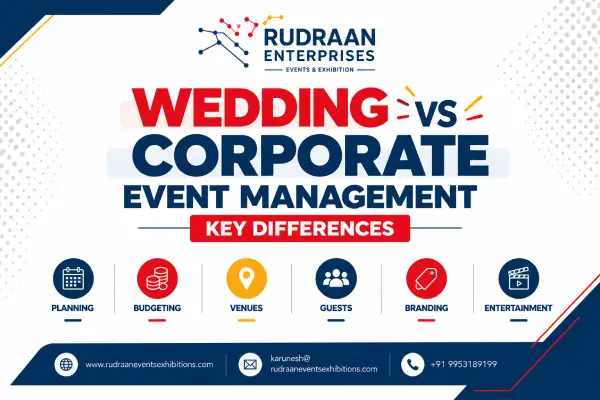
Wedding events and corporate events may both require professional planning, vendors, venues, decoration, catering, entertainment, and guest management, but the way these events are planned and executed can be very different.
A wedding is usually centred around personal celebrations, emotions, traditions, and family experiences, while a corporate event is generally built around business objectives, professional communication, networking, branding, or employee engagement.
Understanding these differences can help you choose the right planning approach and event management partner for your requirements.
In this guide, we compare wedding vs corporate event management across planning, budgeting, venues, branding, entertainment, guest experience, logistics, and execution.
What Is Wedding Event Management?
Wedding event management involves planning and coordinating the different elements required to create a memorable wedding celebration.
Depending on the type of wedding, the planning process can include:
- Venue selection
- Wedding theme and décor
- Guest management
- Catering
- Photography and videography
- Entertainment
- Wedding invitations
- Stage and mandap setup
- Lighting
- Bride and groom entry
- Family coordination
- Guest accommodation
- Transportation
- Wedding ceremonies
- Vendor management
Wedding planning often involves several functions taking place across one or multiple days.
The event manager needs to coordinate these elements while maintaining the couple’s preferred style, traditions, schedule, and overall guest experience.
What Is Corporate Event Management?
Corporate event management focuses on planning events for businesses, organizations, brands, employees, clients, partners, and other professional audiences.
Corporate events can include:
- Conferences
- Seminars
- Product launches
- Dealer meets
- Annual celebrations
- Award ceremonies
- Corporate parties
- Networking events
- Employee engagement events
- Business meetings
- Brand activations
Corporate event management typically places greater emphasis on the company’s objectives, brand identity, communication, professional presentation, and measurable outcomes.
Wedding vs Corporate Event Management: At a Glance
| Factor | Wedding Event Management | Corporate Event Management |
|---|---|---|
| Primary Purpose | Celebration and personal milestone | Business or organisational objective |
| Main Audience | Family, friends and guests | Employees, clients, partners and stakeholders |
| Planning Style | Personalised and emotion-focused | Structured and objective-focused |
| Branding | Theme and personal identity | Corporate brand identity |
| Décor | Often highly customised | Professional and brand-aligned |
| Entertainment | Music, performances, DJs and artists | Hosts, performances, music and activities |
| Guest Experience | Hospitality and celebration | Engagement, networking and communication |
| Schedule | Ceremonies and celebrations | Agenda, sessions and programme |
| Budget | Based on personal priorities | Often tied to business objectives |
| Success Measurement | Guest satisfaction and experience | Engagement, objectives and business outcomes |
1. The Purpose of the Event Is Different
The biggest difference between the two is the reason behind the event.
Wedding Events
A wedding is primarily a personal celebration.
The event may focus on:
- Celebrating the couple
- Bringing families together
- Following cultural traditions
- Creating memorable experiences
- Hosting guests
- Celebrating important ceremonies
The planning process is therefore highly personal.
Corporate Events
A corporate event generally has a defined organisational objective.
For example, a business may organise an event to:
- Launch a product
- Train employees
- Recognise achievements
- Meet business partners
- Generate leads
- Strengthen relationships
- Communicate business information
- Celebrate company milestones
The event design and execution should support that objective.
2. The Audience Is Different
Understanding the audience is essential for both types of events.
Wedding Audience
Wedding guests may include:
- Immediate family
- Relatives
- Friends
- Colleagues
- Community members
- Special guests
The experience often needs to accommodate different age groups, cultural expectations, and family preferences.
Corporate Audience
Corporate events may include:
- Employees
- Business owners
- Senior executives
- Clients
- Dealers
- Distributors
- Investors
- Partners
- Industry professionals
The event environment generally needs to reflect the expectations of a professional audience.
3. Planning Approach
Wedding planning and corporate event planning require different approaches.
Wedding Planning
Wedding planning often involves coordinating multiple ceremonies and celebrations.
For example:
Engagement → Mehendi → Haldi → Sangeet → Wedding → Reception
Not every wedding follows the same format, but multiple functions can make the planning process more detailed.
Corporate Event Planning
Corporate events usually follow a structured programme.
A typical format could be:
Guest Arrival → Registration → Welcome → Presentation → Main Session → Networking → Entertainment → Closing
The timeline is generally designed around business objectives and programme requirements.
4. Venue Requirements Are Different
Venue selection depends heavily on the type of event.
Wedding Venue
A wedding venue may need to accommodate:
- Ceremony areas
- Dining
- Stage
- Dance floor
- Guest seating
- Décor
- Photography
- Entertainment
- Family requirements
For larger weddings, accommodation and guest transportation may also become important.
Corporate Event Venue
A corporate event venue may need:
- Conference seating
- Stage
- Presentation area
- LED screens
- Audio-visual equipment
- Registration area
- Networking space
- Meeting rooms
- Branding areas
The venue should support the event’s professional programme and technical requirements.
5. Décor and Design Have Different Priorities
Décor plays an important role in both weddings and corporate events, but the creative direction is usually different.
Wedding Décor
Wedding décor can focus on:
- Floral arrangements
- Mandap design
- Stage décor
- Entrance décor
- Table settings
- Lighting
- Colour themes
- Photo areas
- Traditional elements
The design is often based on the couple’s preferences and wedding theme.
Corporate Event Décor
Corporate event design often focuses on:
- Brand colours
- Company logo
- Stage design
- Backdrops
- LED screens
- Corporate signage
- Product displays
- Professional lighting
- Brand messaging
The environment should support the company’s identity and event objective.
6. Branding Is More Prominent in Corporate Events
Branding can exist in weddings, but it is generally much more central to corporate events.
A company may need its identity incorporated into:
- Stage design
- LED screens
- Entrance signage
- Backdrops
- Registration counters
- Presentation screens
- Product displays
- Directional signage
- Event collateral
For a product launch or brand activation, the entire event environment may be designed around the brand.
Wedding events, meanwhile, may use personalised names, monograms, initials, themes, or colour palettes rather than corporate branding.
7. Entertainment Requirements Differ
Entertainment is important in both types of events, but the choice depends on the audience and purpose.
Wedding Entertainment
Wedding entertainment can include:
- DJ
- Live band
- Dance performances
- Celebrity performances
- Traditional performances
- Couple entries
- Family performances
- Choreographed shows
Entertainment is often a major part of the celebration.
Corporate Event Entertainment
Corporate entertainment may include:
- Professional host or emcee
- Live music
- DJ
- Stand-up performances
- Cultural performances
- Interactive activities
- Team-building activities
- Celebrity appearances
The entertainment should generally fit the audience and overall corporate environment.
8. Catering Requirements
Food and hospitality are important for both weddings and corporate events.
However, the requirements can differ.
Wedding Catering
Wedding catering may include a large variety of:
- Starters
- Main courses
- Desserts
- Regional cuisines
- Live counters
- Beverages
- Special dietary options
Food presentation and variety can become an important part of the overall wedding experience.
Corporate Catering
Corporate catering may focus more on:
- Business lunches
- Conference refreshments
- Tea and coffee
- Networking snacks
- Buffet meals
- Formal dinners
- Executive dining
The menu and service style should suit the event schedule and professional audience.
9. Budget Planning Is Different
Both events require careful budget management, but the priorities can vary.
Wedding Budget
A wedding budget may be distributed across:
- Venue
- Décor
- Catering
- Photography
- Entertainment
- Guest accommodation
- Transportation
- Invitations
- Wedding attire
- Ceremonies
Personal preferences can significantly influence spending decisions.
Corporate Event Budget
Corporate event budgets may include:
- Venue
- Stage and production
- Audio-visual equipment
- Branding
- Catering
- Entertainment
- Guest management
- Event staff
- Photography
- Transportation
- Technology
- Exhibition or product displays
Businesses may also evaluate expenditure against specific event objectives.
10. Guest Experience Is Different
Guest experience matters in both cases, but the desired experience can be different.
Wedding Experience
The goal is often to make guests feel:
- Welcomed
- Comfortable
- Celebrated
- Entertained
- Emotionally connected
Hospitality and personal attention are important.
Corporate Experience
Corporate guests may need:
- Efficient registration
- Clear directions
- Comfortable seating
- Good visibility
- Professional presentations
- Networking opportunities
- Smooth transitions
- Timely communication
The event should feel organised and professional.
11. Vendor Coordination
Both weddings and corporate events may require multiple vendors.
Wedding Vendors
A wedding can involve:
- Decorators
- Caterers
- Photographers
- Makeup artists
- Entertainment teams
- Florists
- Transportation providers
- Invitation designers
- Venue teams
Corporate Event Vendors
Corporate events may involve:
- Stage fabricators
- AV teams
- Lighting companies
- Branding teams
- Caterers
- Entertainment providers
- Event staff
- Photographers
- Transportation providers
The event manager coordinates these different teams so that the overall event works as one experience.
12. Event-Day Execution
Event-day execution is critical for both event types.
Wedding Execution
The event team may coordinate:
- Ceremony timings
- Bride and groom entries
- Family members
- Performances
- Catering
- Guest movement
- Photography
- Décor
- Entertainment
Corporate Execution
The event team may coordinate:
- Speaker arrivals
- Registration
- Presentations
- Stage sessions
- Technical equipment
- Brand displays
- Entertainment
- Catering
- Guest movement
- Event schedule
In both cases, a detailed event-day run sheet can help keep everyone aligned.
13. Technology Requirements
Technology can play an important role in both weddings and corporate events.
For weddings, technology may include:
- LED screens
- Special lighting
- Projection
- Music systems
- Photo booths
- Digital invitations
Corporate events may require more presentation-focused technology such as:
- LED walls
- Presentation systems
- Professional sound
- Live streaming
- Interactive screens
- Digital registration
- Product demonstration systems
The technology should be selected according to the event’s actual requirements.
14. How Success Is Measured
One of the biggest differences between wedding and corporate events is how success is evaluated.
Wedding Success
A wedding may be considered successful when:
- Guests enjoy themselves
- Ceremonies run smoothly
- Families are satisfied
- The couple has a memorable experience
- Hospitality is well managed
Corporate Event Success
A business may evaluate:
- Attendance
- Audience engagement
- Lead generation
- Networking
- Brand visibility
- Employee participation
- Client feedback
- Business outcomes
The measurements depend on the purpose of the event.
Can One Event Management Company Handle Both?
Yes, an experienced event management company can potentially manage both wedding and corporate events, provided it has the appropriate experience, team, vendor network, and production capabilities.
However, the planning approach should not simply be copied from one event type to another.
A wedding requires an understanding of personal preferences, family coordination, traditions, and celebrations.
A corporate event requires an understanding of business objectives, professional communication, branding, production, and audience engagement.
The event management approach should therefore be customised according to the event.
How to Choose the Right Event Management Partner
Whether you’re planning a wedding or corporate event, evaluate the event management company before making a decision.
Check Their Experience
Review whether they have handled events similar to yours.
Review Their Portfolio
Look at previous projects to understand their creative and execution capabilities.
Understand Their Services
Check whether they can coordinate the major requirements of your event.
Discuss Your Budget
A clear budget discussion can help avoid misunderstandings later.
Ask About Event-Day Support
Find out who will be responsible for coordination and troubleshooting during the event.
Evaluate Communication
Good communication is important because event planning involves multiple decisions, vendors, deadlines, and changes.
Wedding vs Corporate Event Management: Which Approach Is Right for You?
There isn’t one planning approach that works for every event.
Your requirements should determine the planning process.
If you are planning a wedding, focus on personalisation, hospitality, traditions, family coordination, décor, and celebration.
If you are planning a corporate event, focus on business objectives, branding, professional presentation, audience engagement, networking, and measurable outcomes.
The key is to select an event management approach that matches the purpose and audience of your event.
Why Rudraan Events & Exhibitions?
Rudraan Events & Exhibitions provides event management support across corporate events, exhibitions, weddings, and entertainment requirements.
For weddings, the planning approach can focus on creating a personalised celebration while coordinating décor, entertainment, hospitality, vendors, and event-day requirements.
For corporate events, the focus can shift toward professional planning, branding, production, guest experience, and smooth execution.
The objective is to understand the requirements of each event and coordinate the different elements into one organised experience.
Final Thoughts
While weddings and corporate events share several event-management fundamentals, their objectives, audiences, planning styles, branding requirements, entertainment, budgets, and success measurements can be very different.
A wedding is primarily a personal celebration built around people, traditions, emotions, and memorable experiences.
A corporate event is generally structured around business objectives, professional communication, brand experience, networking, or employee engagement.
Understanding these differences makes it easier to plan the right event and choose the right professional support.
Planning a Wedding or Corporate Event?
Whether you’re organising a memorable wedding celebration or a professional corporate event, Rudraan Events & Exhibitions can help coordinate the planning and execution process according to your requirements.
Corporate Events | Exhibitions | Weddings | Entertainment
CTA:
Plan Your Next Event With Rudraan Events & Exhibitions